

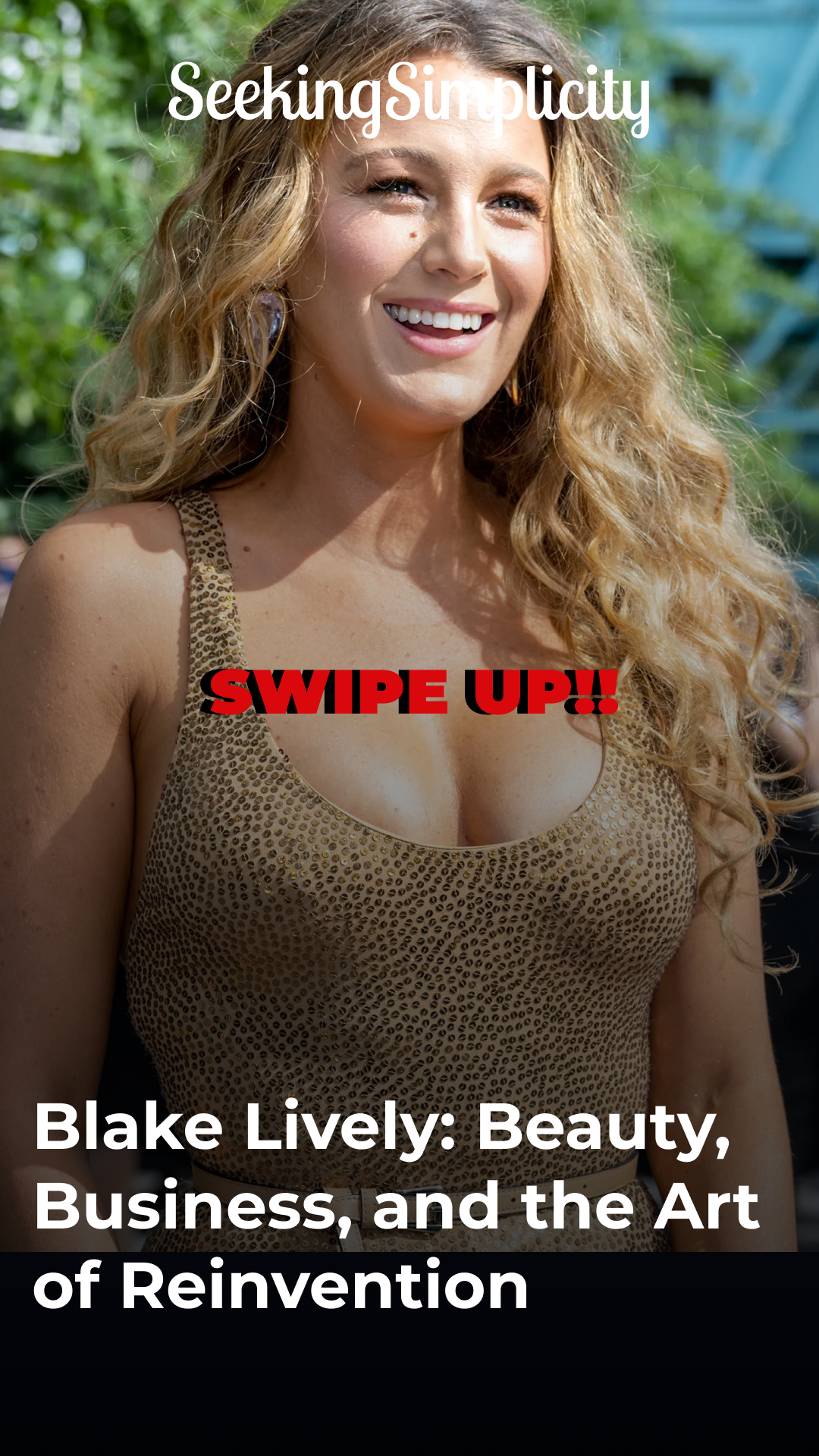
Hollywood is often accused of packaging women into archetypes—the ingénue, the bombshell, the wife, the mother. Yet Blake Lively has managed to elude these labels, consistently reinventing herself in a career that has spanned over two decades. She is beautiful, yes—but what makes her fascinating is the way she has blended acting, entrepreneurship, motherhood, and fashion into one seamless public identity.
The Early Spark
Born in Los Angeles in 1987 to a family of actors, Blake Lively’s entry into Hollywood seemed almost predestined. Yet her rise was not automatic. She initially planned to attend Stanford University before being persuaded to audition for films. Her breakout role came with The Sisterhood of the Traveling Pants (2005), where she played the athletic and charismatic Bridget.
Audiences were captivated by her warmth and vitality. Unlike other teen actresses who leaned into angst or cynicism, Lively radiated sunshine—a quality that became her trademark in the years to follow.
Gossip Girl: Becoming a Cultural Icon
Lively’s career took a seismic leap with Gossip Girl (2007–2012), the CW series that became a cultural phenomenon. As Serena van der Woodsen, the glamorous yet troubled Upper East Sider, she embodied the contradictions of privilege, vulnerability, and allure.
The role made her a global style icon. Teenagers mimicked Serena’s outfits; magazines splashed Lively across covers; suddenly, she was more than an actress—she was a trendsetter. Yet unlike many TV stars pigeonholed by signature roles, Lively used Gossip Girl as a platform to diversify.
Transition to Film
Post-Gossip Girl, Lively avoided predictable romantic comedies. Instead, she chose projects that allowed her to demonstrate range. In The Town (2010), directed by Ben Affleck, she stunned critics with her raw portrayal of a working-class single mother entangled in crime. It was a performance that silenced skeptics who dismissed her as merely a fashion darling.
She followed with Savages (2012), where she played O, a woman at the center of a violent love triangle, and The Age of Adaline (2015), where she embodied a woman cursed with eternal youth. The latter showcased her ability to channel both elegance and melancholy.
But perhaps her most defining role in recent years was The Shallows (2016), a survival thriller where she carried almost the entire film alone, facing off against a great white shark. It was a risky choice that proved her mettle as a leading actress capable of commanding the screen.
Style Maven and Fashion Force
Blake Lively’s beauty is often framed through her relationship with fashion. She is one of the few celebrities who styles herself without professional help, curating bold and sophisticated looks for red carpets. Her ensembles—whether at the Met Gala or film premieres—are dissected by critics and adored by fans.
What makes her style powerful is its narrative quality. Every look tells a story, blending glamour with experimentation. She has turned fashion into a language of self-definition, elevating her beauty into artistry.
Entrepreneurial Vision
Beyond acting and fashion, Lively has ventured into entrepreneurship. In 2021, she launched Betty Buzz, a line of non-alcoholic mixers, and more recently, Betty Booze. Her approach to business reflects the same discipline she applies to acting—careful curation, authenticity, and attention to detail.
Unlike celebrities who lend their names passively, Lively immerses herself in branding and promotion. She engages directly with consumers, leveraging her relatability and wit to cultivate loyalty. Through these ventures, she proves that beauty and entrepreneurship are not mutually exclusive—they can reinforce each other.
Family Life in the Spotlight
Married to actor Ryan Reynolds, Lively has built a high-profile family life that paradoxically feels private. Together, they have four children, but both she and Reynolds maintain boundaries with humor and discretion. Their playful banter on social media has endeared them to fans, offering glimpses of intimacy without oversharing.
Lively’s ability to balance motherhood and career enhances her relatability. She has spoken candidly about the pressures of postpartum changes and the challenges of parenting, offering honesty in an industry often obsessed with perfection.
Beauty as Agency
What distinguishes Lively’s beauty is her ownership of it. She does not deny or downplay it, but neither does she allow it to define her. In The Age of Adaline, beauty became a metaphor for timelessness and burden; in her fashion choices, it is a medium of storytelling; in her personal life, it is one facet of a multidimensional identity.
Her beauty is not passive—it is wielded with intentionality, used to craft narratives that reinforce independence rather than dependency.
Why Blake Lively Endures
Blake Lively endures because she refuses to be trapped by Hollywood’s reductive archetypes. She is at once actress, style icon, entrepreneur, wife, and mother, embodying all roles without diminishing any of them. She demonstrates that beauty is not fragility but resilience, not limitation but expansion.
Her legacy will not be confined to a single role or franchise. Instead, it will be defined by the way she navigated Hollywood and beyond—with intelligence, reinvention, and authenticity.
Conclusion
Blake Lively represents a new model of celebrity—one that blends artistry, entrepreneurship, and authenticity with timeless beauty. She is proof that reinvention, not conformity, sustains longevity in Hollywood. Her story continues to evolve, but one truth remains constant: she is more than just a beautiful celebrity woman; she is a cultural force shaping the future of fame.
